Written by M. Haroon | Last updated: September 2026
A low taper is a classic men’s haircut that keeps the sides and back short around the ears and neckline, then gradually lengthens toward the crown. The taper begins about an inch above the ear, so it looks cleaner and softer than a high taper or skin fade. Barbers usually create it with clippers and guards, often starting with a #1 at the hairline and blending into a #2 or #3.
This versatile cut suits straight, wavy, curly, and coily hair, and works with most face shapes, from oval to square. Whether you choose a crew cut, textured crop, or natural curls on top, the result stays sharp and professional. Below, you’ll learn how to ask your barber for it, style it, and maintain it.
What Is a Low Taper Haircut?

A low taper is a men’s cut where the hair shortens gradually around the sideburns, ears and nape. The longest hair stays on top. The shortest hair sits along the hairline. Nothing stops in a hard line. The eye reads the whole shape as one smooth curve.
The word “low” tells you where the change happens. It stays close to the hairline. You keep more length on the sides than you would with a mid or high cut. Less scalp shows, and the finish looks softer and more natural.
A barber builds the taper with clippers and guards. Guards are plastic combs that set the cutting length. The barber works from short to long. The clipper lifts away from the skin as the hair gets longer. Many barbers blend the last inch with scissors or clipper over comb. That blend is where skill shows. A good taper has no steps and no stripes.
Where a Low Taper Starts and Stops

No fixed measurement exists, because heads differ. As a rule, the taper begins about an inch above the ear along the lower sideburn. It ends at the natural hairline on the neck. Many barbers use the curve of the sideburn as a guide. They split it into thirds. A low taper sits in the bottom third. A mid taper sits in the middle. A high taper sits in the top third.
Why Taper and Fade Get Mixed Up

Even barbers use these words differently. StyleSeat, a booking platform for beauty professionals, says many people use “taper” and “fade” interchangeably. Some barbers say a taper never reaches bare skin. Others say a taper only works the edges, such as the neckline and sideburns. A fade covers more area and often ends at skin.
Terms vary by barber and by region. The phrase “taper fade” is not one fixed cut either. Treat it as a request for a soft, blended finish. Describe the look you want. Show a photo and give a guard number. That removes the guesswork.
Low Taper vs Low Fade vs Mid, High and Skin Taper
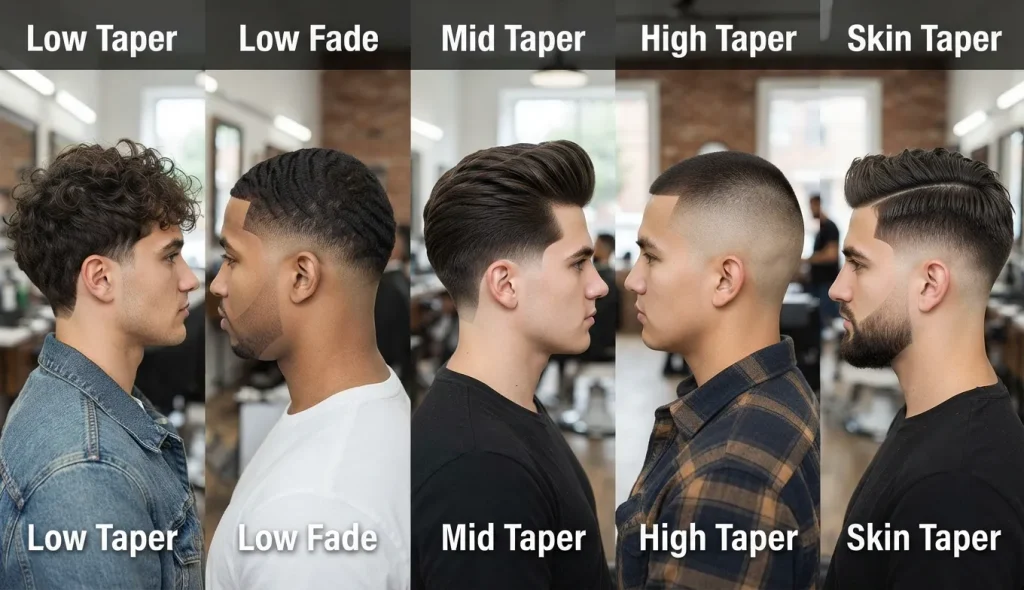
The table below compares the most common options. Heights and upkeep are typical, not fixed rules.
| Cut | Where it starts | Contrast | Scalp shown | Typical upkeep |
| Low taper | About an inch above the ear | Soft | Little or none | 2 to 4 weeks |
| Low fade | Low on the sides, often wraps to the back | Medium | Some, if taken to skin | 2 to 3 weeks |
| Mid taper | Near the temple | Medium | Some | 2 to 3 weeks |
| High taper | Near the top of the ear or higher | Strong | More | About 2 weeks |
| Skin taper | Any height, ends at bare skin | Strong at the edge | Yes | About 2 weeks |
The main difference is contrast. A low taper stays soft and needs fewer visits. A fade, a high taper or a skin taper adds contrast and needs more upkeep.
Low Taper vs Low Fade
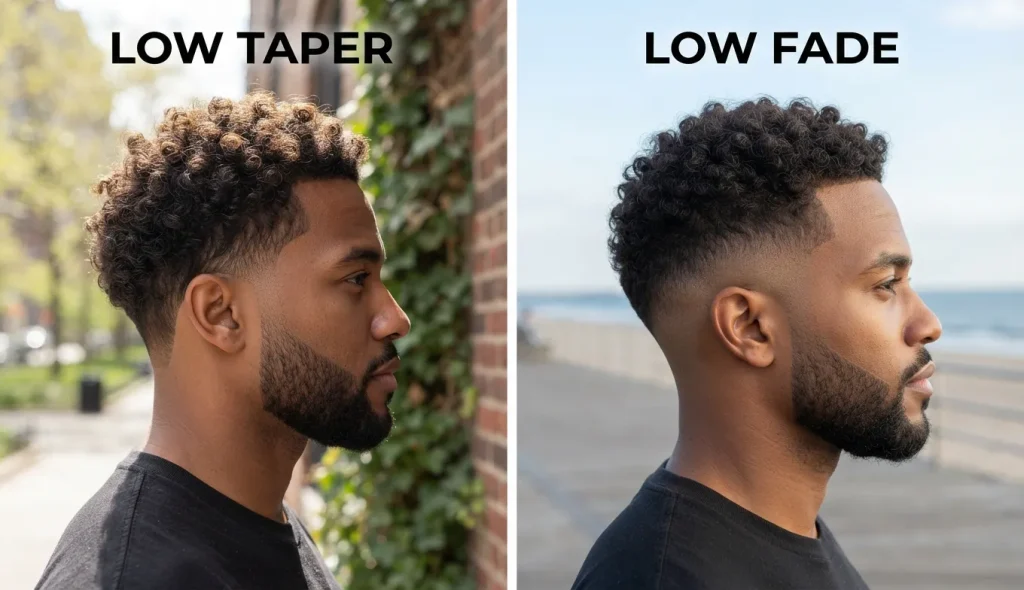
Both start low. A low fade usually travels further around the sides and back. It often goes down to skin. A low taper focuses on the temples, sideburns and neckline and keeps more length. If you want the smallest change from your current cut, pick the taper.
Low Taper vs Mid Taper
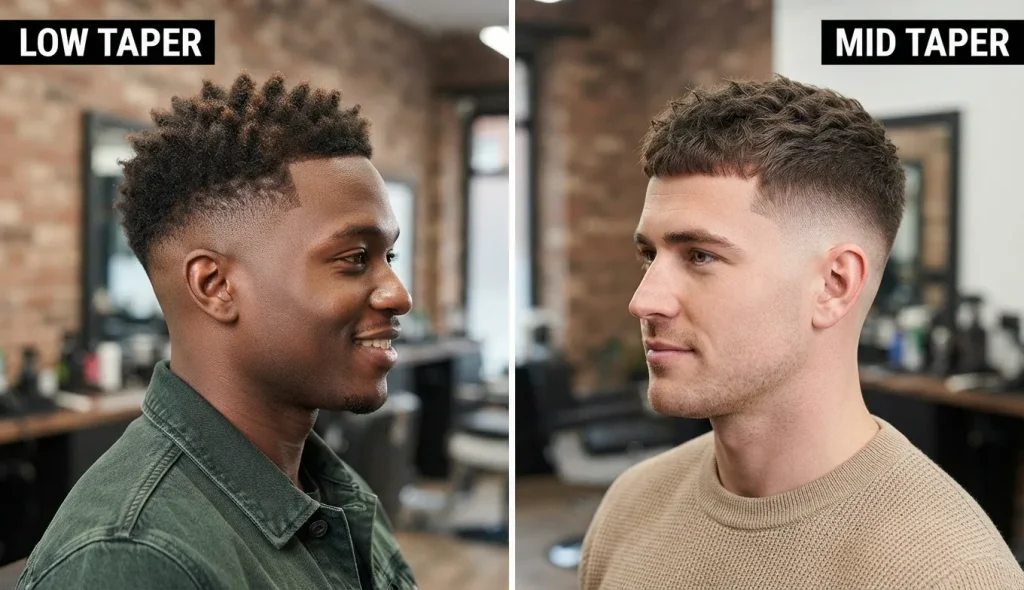
A mid taper starts near the temple. It shows more contrast and a shorter side profile. It suits thick hair well because it removes more bulk. A low taper keeps the sides fuller and looks more relaxed.
READ MORE : Mid Taper Fade Guide: Styles & Face Shapes (2026)
Other Terms You Will Hear
A temple taper works only around the temples. A burst fade curves around the ear and leaves length at the back. A drop fade dips lower behind the ear. Each one changes the shape, so name the exact look you want.
Who Suits a Low Taper Haircut?
Almost any man can wear this cut. Hair type and face shape change how you should cut and style it.
By Hair Type
Each hair type needs a slightly different plan:
- Straight hair: Clean lines show clearly, so ask for a precise blend. A side part or textured crop works well.
- Fine hair: Leave more density on top. Too much texturizing can expose the scalp and make hair look thinner.
- Wavy hair: The taper frames natural movement. Keep 2 to 4 inches on top so the wave shows.
- Curly and coily hair: The sides stay tidy while the curls keep their shape on top. Ask for a careful blend, since tight curls can hide uneven lines.
- Thick or coarse hair: The barber should remove bulk at the sides. Enough weight must stay above to hold the shape.
- Thinning hair: Keep the top longer and textured. Very short tops with high contrast can make thin areas easier to see.
A receding hairline needs one extra step. A side swept fringe or a forward textured top softens the front.
By Face Shape
- Round face: Add height on top with a quiff or textured crop. The taper alone will not lengthen the face.
- Square face: The taper keeps the jawline strong without adding harshness.
- Oval face: Nearly any top style works.
- Long face: Keep some weight at the sides. Avoid very short tops. A fringe shortens the look.
For School, Work and Different Ages
The cut is a safe request for boys and teens. Ask for a longer guard on the sides and a soft blend. At work, the neat hairline reads as professional. Men over 40 often like it because it tidies the edges and needs little daily effort.
Low Taper Styles by Top Length
The taper stays the same. The top decides the style. Lengths below are approximate.
Short Tops (Under 2 Inches)
- Crew cut: Short and even, about an inch or less on top.
- Textured crop: Choppy layers of 1 to 2 inches, styled forward.
- French crop: A short fringe with a blunt line across the forehead.
- Buzz cut: One guard length on top. This has the lowest upkeep.
Medium Tops (2 to 5 Inches)
- Side part: A clean part that works with a comb or fingers.
- Comb over: Hair combed to one side, often with a hard part.
- Quiff: The front lifts up and back for height.
- Pompadour: A high front sweep with volume.
- Textured fringe: A forward, messy top with a matte finish.
Long Tops (5 Inches or More)
- Slick back: Hair combed straight back with pomade or gel.
- Man bun or top knot: The long top is tied up while the sides stay tapered.
- Mullet: Short sides with extra length at the back.
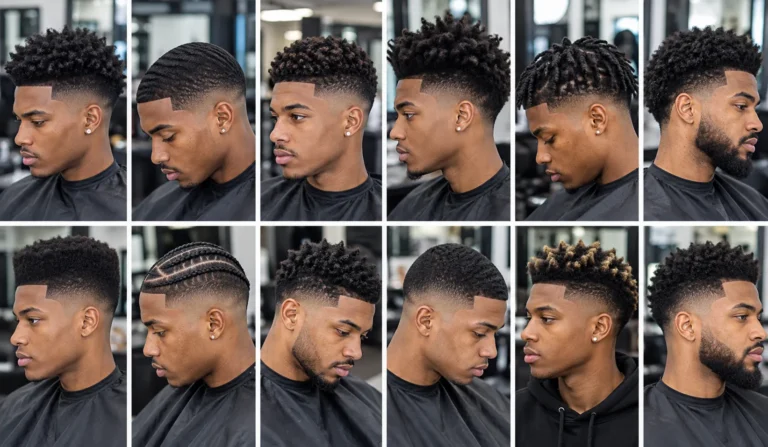
Curly and Coily Tops
- Curly top: Defined curls with a tidy edge.
- Cropped afro: A rounded shape with clean sides.
- Twists and locs: Longer texture with a neat hairline.
- 360 waves: Brushed waves that need a wave brush and nightly care.
- High top: Height on top with a tight, low blend.
Quick Spec for the Most Requested Styles
Use this table to match a style to your hair before you book.
| Style | Top length | Best hair type | Product |
| Textured crop | 1 to 2 inches | Straight, wavy, thick | Matte clay |
| French crop | 1 to 2 inches | Straight, wavy | Paste |
| Side part | 2 to 4 inches | Straight, fine | Pomade or paste |
| Quiff | 3 to 5 inches | Straight, thick | Clay and a blow dry |
| Curly top | 2 to 4 inches | Curly, coily | Styling cream |
| Slick back | 4 inches or more | Straight, wavy, thick | Pomade |
Pick the top by hair type first. Then think about how much time you want to spend each morning.
Clipper Guard Cheat Sheet: What to Tell Your Barber
Guard numbers give your barber a clear target. The table lists the common sizes.
| Guard | Length in inches | Length in mm | Common use in a low taper |
| Blade only (zero) | 0 | 0 | Bare skin at the edge |
| #0.5 | 1/16 | 1.5 | Very close edge |
| #1 | 1/8 | 3 | Shortest length at the hairline |
| #2 | 1/4 | 6 | Lower blend zone |
| #3 | 3/8 | 10 | Upper blend zone |
| #4 | 1/2 | 13 | Longer sides for a soft look |
Sizes follow the common US guard set. Other brands vary slightly. A typical low taper haircut uses a #1 at the hairline. It then blends into a #2 or #3 before meeting the top. Choose a #2 at the base if you want less scalp showing.
A Four Part Script
Cover four points, in this order:
- Height: Say “low taper” and point to where it should start, about an inch above the ear.
- Shortest length: Name the guard at the base, such as a #1. Say “skin” only if you want bare edges.
- Blend: Ask for a soft, tight blend with no lines.
- Top: Give the length in inches and name the style.
Here is an example: “I want a low taper. Start it an inch above my ear. Use a #1 at the bottom and blend into a #3. Leave three inches on top for a side part.”
Words That Cause Trouble
“Just clean it up” means something different to every barber. So does “short back and sides.” “Make it short” could mean any length. Asking for a “fade” often pushes a barber toward more contrast. “Same as last time” only helps if last time went well.
Bring Photos

Show the front, side and back. Point to what you like in each photo. Say what you want to avoid. Mention your crown and any cowlick. A photo gives the visual target. Your barber adjusts it for your density and growth pattern.
How Much Does a Low Taper Haircut Cost and How Long Does It Take?
Prices depend on the city, the shop and the barber. Most shops charge a taper like a standard men’s cut. Some add a fee for skin work, a line up or beard blending. Ask before you sit down. Many cuts take 30 to 45 minutes. Add time if you want a beard blended in. Look for a barber who posts close up photos of tapers. That shows they can blend.
How to Style a Low Taper Haircut at Home
The taper does the hard work. Your styling only needs to shape the top. Follow these steps:
- Start with towel dried, slightly damp hair.
- Spray sea salt or a pre-styler at the roots if your hair falls flat.
- Blow dry with your fingers. Lift the roots and point the air where you want the hair to go.
- Warm a small amount of product between your palms. Work it through the top only.
- Shape with your fingers or a comb. Add more products only if you need it.
Keep product off the tapered sides. Buildup dulls the blend. Less product also looks better. Heavy products flattens texture and can show scalp on fine hair.
Choose the product by the finish you want:
| Product | Finish | Hold | Best for |
| Matte clay | Matte | Strong | Textured crops and messy tops |
| Paste | Matte to natural | Medium | Most short and medium tops |
| Pomade | Shine | Medium to strong | Slick backs and side parts |
| Sea salt spray | Natural, gritty | Light | Waves, fluffy tops and a base layer |
| Styling cream | Natural | Light | Frizz control and curls |
| Texture powder | Matte | Light | Root lift and volume |
Match the routine to your hair. Straight hair needs grip, so start with a spray. Curly hair needs moisture, so use a cream. Fine hair does best with powder.
Low Taper Grow Out Timeline
The American Academy of Dermatology says scalp hair grows about half an inch a month. That equals roughly a quarter inch in two weeks. It explains why the blend softens so fast.
- Days 1 to 3: Clean edges and a soft blend.
- Week 1: A little fuzz at the neckline. The blend still looks sharp.
- Week 2: The sides gain about a quarter inch. The taper starts to soften.
- Week 3: The hair around the ears looks heavier. The neckline looks uneven.
- Week 4: About half an inch of growth. Most of the shape is gone.
Fast growers see this sooner. A skin taper also shows regrowth earlier, because the contrast is higher. A regular low taper grows out more gracefully, since more length stays on the sides.
How to Maintain a Low Taper Haircut
Good upkeep keeps the blend clean between visits.
READ MORE : Low Taper Fade Curly Hair: Styles, Tips & Barber Guide 2026
Set a Visit Schedule
Plan a trim every 2 to 4 weeks. Choose 2 to 3 weeks if you like it sharp or have a skin taper. Choose 4 weeks if you accept a softer edge. Book the next visit before you leave the chair.
Tidy the Neckline at Home
Use a trimmer for stray hairs at the nape and around the ears. Do it every week if needed. Leave the full line up to your barber. Small mistakes at the neckline show more than anything else.
Look After Your Skin

Short hair at the nape can cause razor bumps. The American Academy of Dermatology explains that bumps form when cut, curly hairs curve back into the skin. They are common in men who shave and especially common in men with darker skin.
Ask your barber to finish the neckline with clippers or a trimmer instead of a razor or foil shaver. Clean your scalp often, and use a clarifying shampoo now and then to remove product buildup.
Low Taper With a Beard
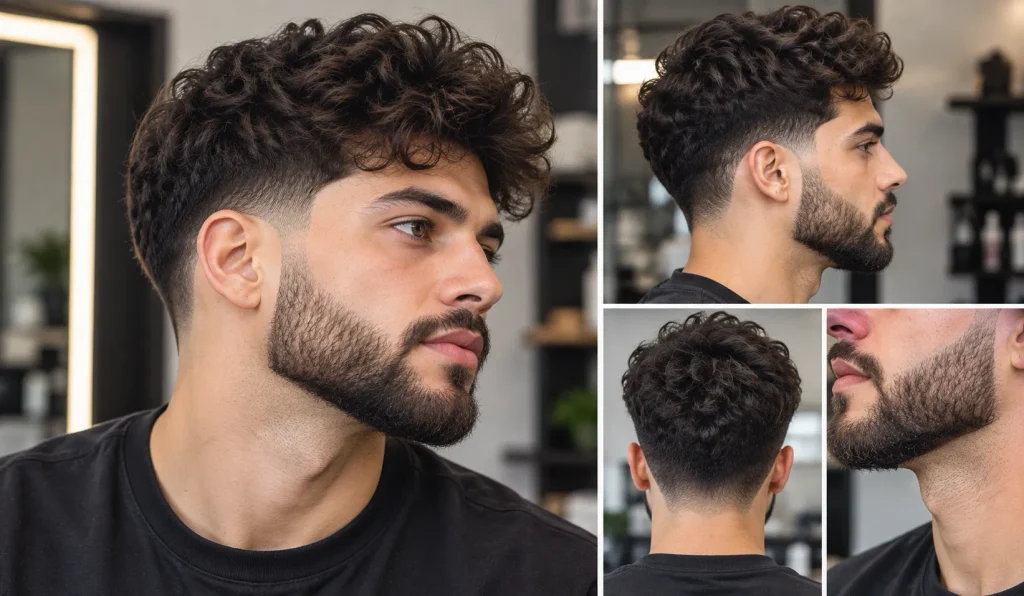
A taper looks best with a beard when the two connect. Ask your barber to blend the sideburns into the beard so no gap shows. Many barbers call this a beard fade.
Keep the neckline of the beard about one to two finger widths above the Adam’s apple. That is a common barbering guide, not a rule. A beard also helps some men with razor bumps, and dermatologists list growing one as a first tip.
Low Taper Haircut FAQs
Is a low taper a fade?
Not exactly. A low taper shortens hair slowly and keeps length at the edges. A fade usually goes shorter and often reaches bare skin. Some barbers use the terms as if they mean the same thing, so describe the look.
Where should a low taper start?
Most start about an inch above the ear and along the lower sideburn. Heads differ, so point to the spot in the mirror. Ask the barber to confirm the height before cutting.
What guard should I ask for?
Most men choose a #1 at the hairline, blended into a #2 or #3. Choose a #2 base for a softer edge. Ask for skin if you want bare edges.
How often should I get a low taper haircut?
Every 2 to 4 weeks. Two to three weeks keeps it sharp. Four weeks works if you like a softer, more natural grow out.
Does it work with thinning or receding hair?
Yes, with the right top. Keep more length and texture up top and style the front forward. Avoid very short tops with high contrast, since they can highlight thin areas.
Can I cut a low taper at home?
You can trim the neckline. Blending the full taper is hard. Uneven lines show fast, and most people need a barber for a clean result.
Is a low taper haircut allowed in Islam?
Scholars separate two things. Qaza’ means shaving part of the head and leaving the rest, and scholars call it disliked. Simply cutting hair shorter in places does not fall under that ruling. Shaykh Faraz A.
Khan (Hanafi) and Shaykh Irshaad Sedick (Shafi’i), both answering for SeekersGuidance, say intent matters too. Copying people known for bad conduct is a problem. Some modern scholars are stricter. A taper taken to bare skin raises more questions than a longer guard. Ask a qualified scholar you trust.
Take This to Your Barber
- Say “low taper” and point to where it starts.
- Name the guard at the hairline.
- Ask for a soft blend with no lines.
- Give your top length in inches.
- Show front, side and back photos.
- Book your next visit for about three weeks out.
Conclusion
A low taper keeps the sides and back short near the ears and neckline, then grows longer toward the top. It starts about an inch above the ear, so it looks softer than a fade or high taper. It suits most hair types and face shapes, and the top length decides the look.
At the barber, be specific about where the taper starts, the guard number, the blend, and the top length. A #1 at the hairline blended into a #2 or #3 is popular. Style only the top, trim every 2 to 4 weeks, and bring clear photos.