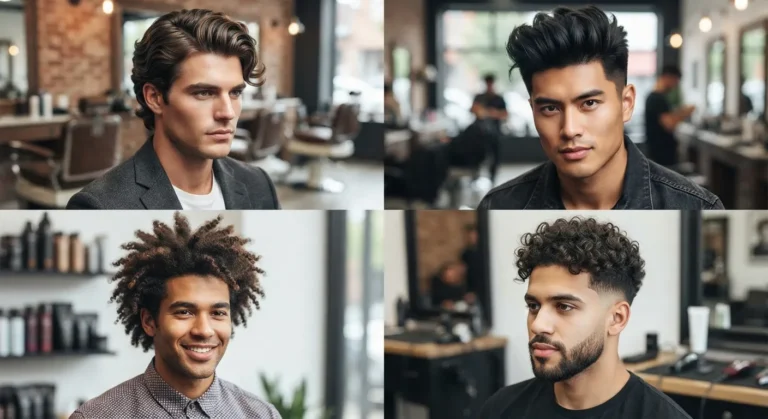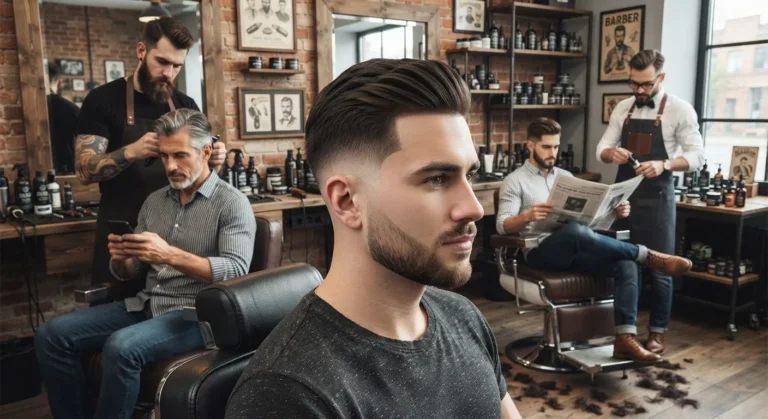
By M. Haroon | Updated September 2026
Most guys walk into a barbershop, say “something like a taper with texture on top,” and walk out with whatever the barber felt like doing that day. That gap between what you picture and what you get is almost always a communication problem. It is rarely a skill problem. The blowout taper textured fringe is one of the most requested men’s cuts right now. It looks simple, but it hides a handful of technical decisions that change the outcome completely. Where the taper starts. How aggressive the point cutting is. How much length survives on top.
This guide walks through those decisions the way a barber actually thinks about them. It covers why certain choices work on certain heads, not just what the cut is called.
What Is Actually Happening When a Barber Cuts This
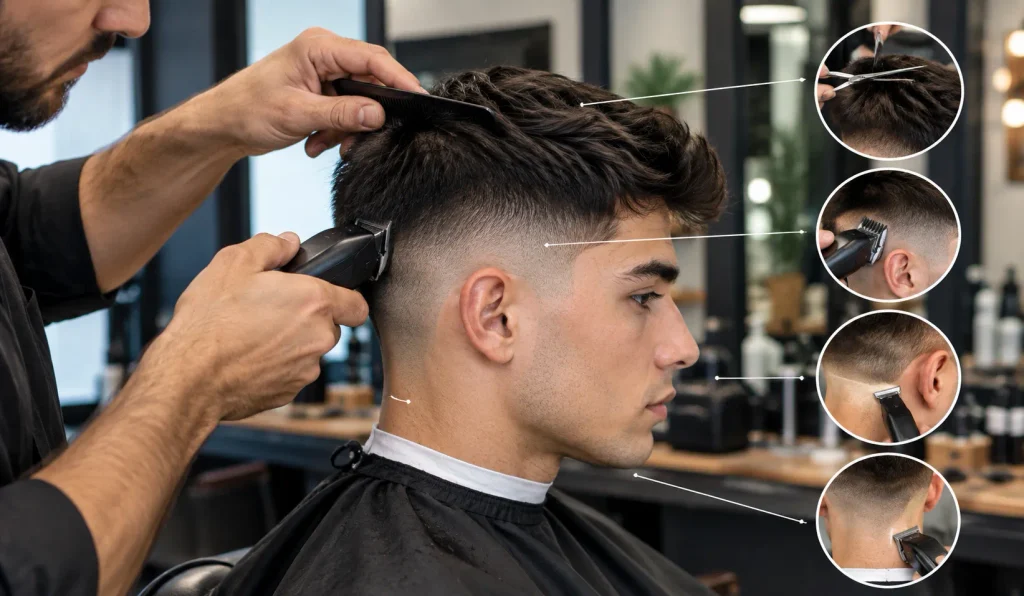
Three separate techniques stack on top of each other here. Knowing which is which matters once you are in the chair.
The taper is clipper work. The barber blends the hair shorter near the neckline and ears. They use a sequence of guard sizes that climb as they move up the head. Unlike a fade, a taper never drops all the way to skin. There is a floor to how short it goes, usually a guard 1 or 2 at its shortest point. That floor is the reason tapers age better than fades. There is no hard skin line to grow out awkwardly.
The blowout is a styling technique, not a cutting technique. This trips people up constantly. It happens after the haircut, when a round brush and blow dryer lift the roots and push the top forward and up. A barber can hand you a perfect taper and fringe. But if nobody blows it out, you just have a normal haircut sitting flat.
The fringe is where the scissors come in. Point cutting, sometimes called notching, means the barber angles the shears into the hair vertically instead of straight across. Some barbers use slide cutting instead, sliding open shears along the hair shaft to remove weight while keeping length. Straight across cuts create one dense, heavy edge. Point cuts and slide cuts break that edge into hundreds of micro lengths. That is what lets the fringe fall with movement instead of sitting like a curtain.
Skip any one of these three and the cut reads differently. No taper, and it is just a long fringe with no frame. No blowout, and the volume dies by early afternoon. No point cutting, and the fringe looks blunt no matter how much product you use.
Taper vs. Fade: Where People Actually Get Confused
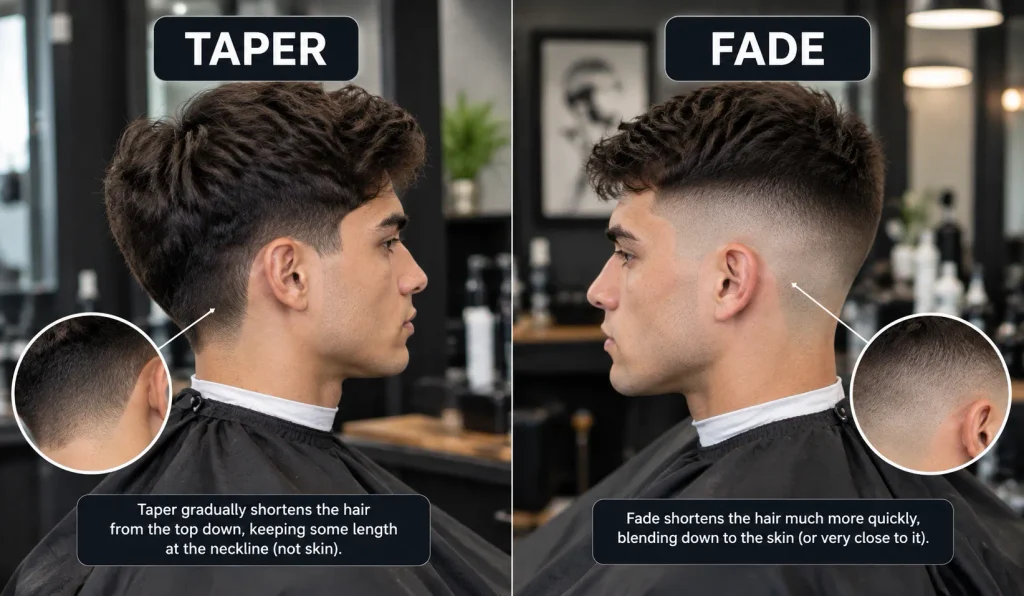
Barbers hear these two words used interchangeably all the time. It is worth being precise, because the wrong word changes what you get.
A fade touches skin somewhere on the head. That is the defining feature, not how gradual the blend looks. A taper never touches skin. Everything else, how sharp the contrast looks or how gradual the blend feels, is a downstream effect of that one rule.
| Taper | Fade | |
| Touches skin | Never | Yes, at some point |
| Regrowth visibility | Gradual, forgiving | Obvious within 10 to 14 days |
| Cut frequency needed | 4 to 6 weeks | 2 to 3 weeks |
| Reads as | Classic, low key | Trend forward, sharper |
| Grows into | Longer hair, still looks intentional | Needs a fresh cut or it looks patchy |
If your calendar has no room for a barber visit every two weeks, a taper is the more realistic choice. Not because a fade looks worse. A fade simply unravels faster and looks rougher when neglected.
Fringe vs. Crop: A Distinction Most Guides Skip
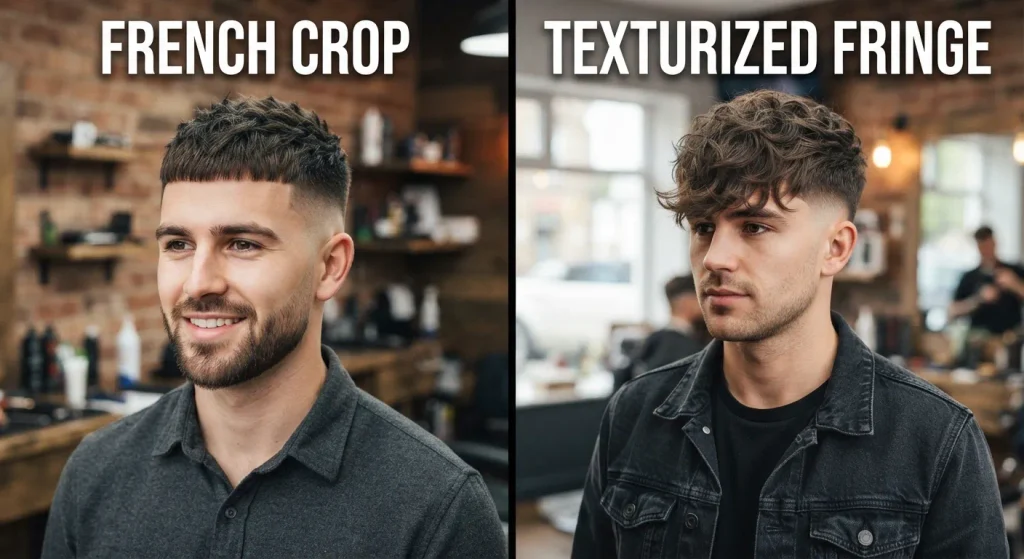
Almost every article on this cut treats fringe and crop as interchangeable. They are not. The difference decides how the front of your hair behaves.
A fringe keeps enough length to actually fall, forward or to one side, wherever the blowout directs it. It has weight, and it moves when you turn your head.
A crop is cut shorter and closer to the forehead. There is less length for the point cutting to work with. Instead of falling, it stands up in short, textured pieces.
Here is the practical rule barbers use. If there is enough length to grab between two fingers and pull forward, it is a fringe. If it is too short to grab, it is a crop. Straight and wavy hair generally suit the fringe better, since the length shows off the point cutting texture. Curly and coarse hair often look better as a crop. The curl pattern already supplies its own volume, and a longer fringe on curly hair can start looking heavy instead of textured.
Choosing Your Taper Height
Taper height is the single biggest lever you control. It is worth understanding what each height costs you in upkeep, beyond how it looks fresh out of the chair.
1. Low taper.
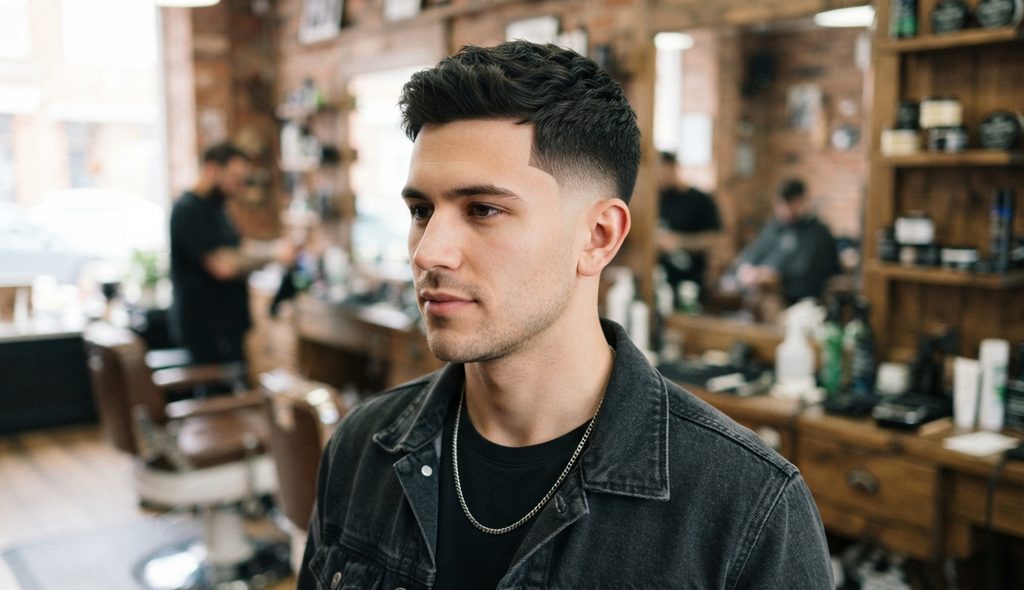
Starts just above the ear and barely fades at all. You can neglect this cut for six weeks and it still looks deliberate. The trade off is subtlety. If you want people to notice the sides, this is not loud enough.
2. Mid taper.
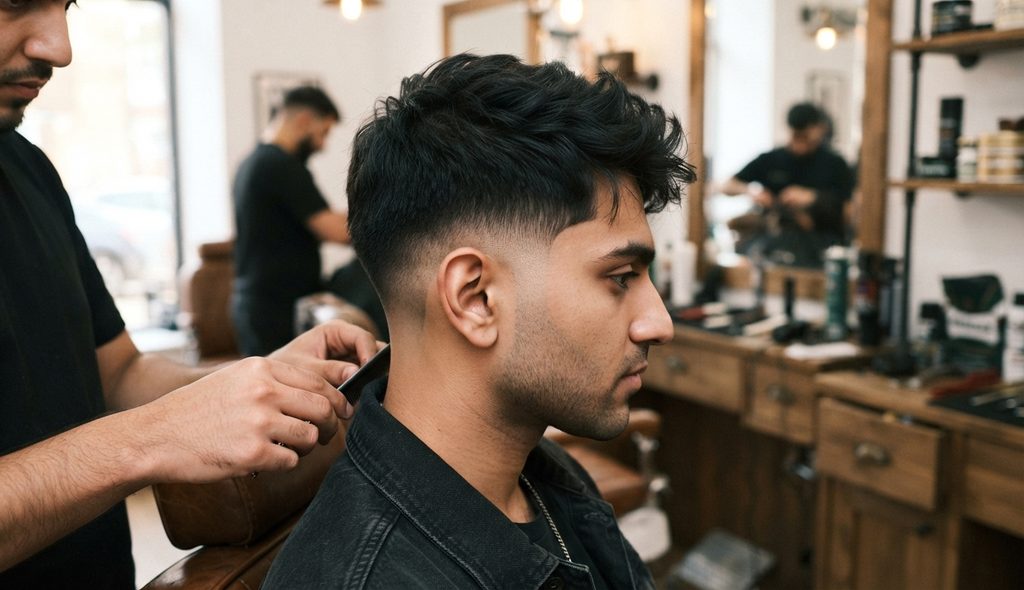
Sits roughly at ear level. This is the default most barbers reach for when someone does not specify a height. It reads as intentional on almost every head shape without demanding weekly maintenance.
3. High taper.
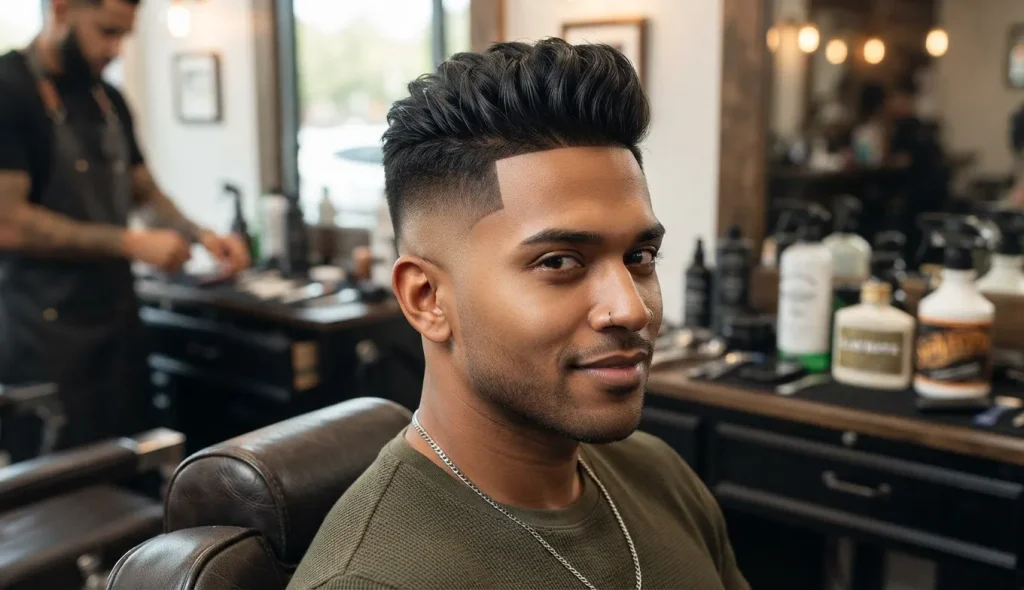
Climbs toward the crown. This is the one that photographs best on day one and looks the roughest by week three, since the regrowth shows up closest to where your eye naturally lands.
Matching Taper Height to Face Shape
Most guides just hand you a table. Here is the logic behind it, since understanding why lets you override the rule when your barber has a good reason to.
- Round faces. A higher taper removes visual width from the sides. The added height on top elongates the face. A low taper on a round face tends to widen it further.
- Square faces. A low to mid taper keeps some length near the jawline, which softens a strong jaw instead of framing it in sharp clipper lines.
- Long or rectangular faces. A low taper avoids stacking more height on an already long face. High tapers here can make the face look stretched.
- Diamond faces. A mid taper balances a narrow forehead against a wider cheekbone line.
- Heart shaped faces. Low to mid taper again, since the goal is softening a wider forehead rather than emphasizing it.
- Oval faces. Genuinely flexible. Almost any height works because there is no dominant angle to correct for.
A barber who is paying attention will glance at your face shape before committing to a guard number. If yours does not, it is worth asking them to.
What to Actually Say in the Chair
Vague language is the number one reason this haircut comes out wrong. Barbers are not mind readers, and “make it look good” gives them permission to interpret however they want.
Say this instead:
- Name your taper height, low, mid, or high, and point to roughly where you want it to start.
- Say how long you want the fringe. “Eyebrow length” or “long enough to grab between two fingers” communicates more than “not too short.”
- Ask for point cutting by name. This is the detail almost nobody says out loud, and it separates a fringe that falls with texture from one that sits like a solid block.
- Bring a reference photo, ideally from more than one angle. A single front facing photo hides what the taper height and back shape actually look like.
If you want to speak in guard numbers, a 0 or skin guard at the neckline is standard for the tightest point. A 1 leaves about an eighth of an inch, and a 2 leaves roughly a quarter inch. Most barbers blend upward through 1s and 2s before switching to scissors for the top and fringe.
Does It Work With Your Hair Type?
Every guide says “it works with all hair types,” which is technically true and practically useless. Here is what actually changes by texture.
Straight hair
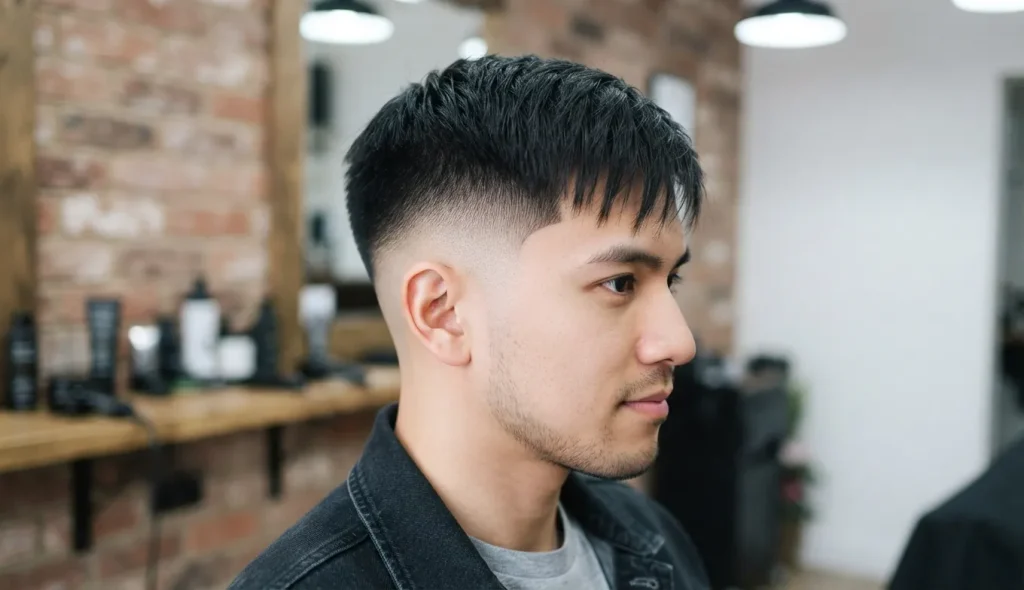
holds a round brush shape the longest of any texture, so it needs the least daily effort. The risk is not volume, it is flatness by mid afternoon, which a light mousse at the roots solves. Straight hair also shows Point Cutting work the most clearly, so ask your barber to be a little more aggressive with the thinning shears here.
Wavy hair
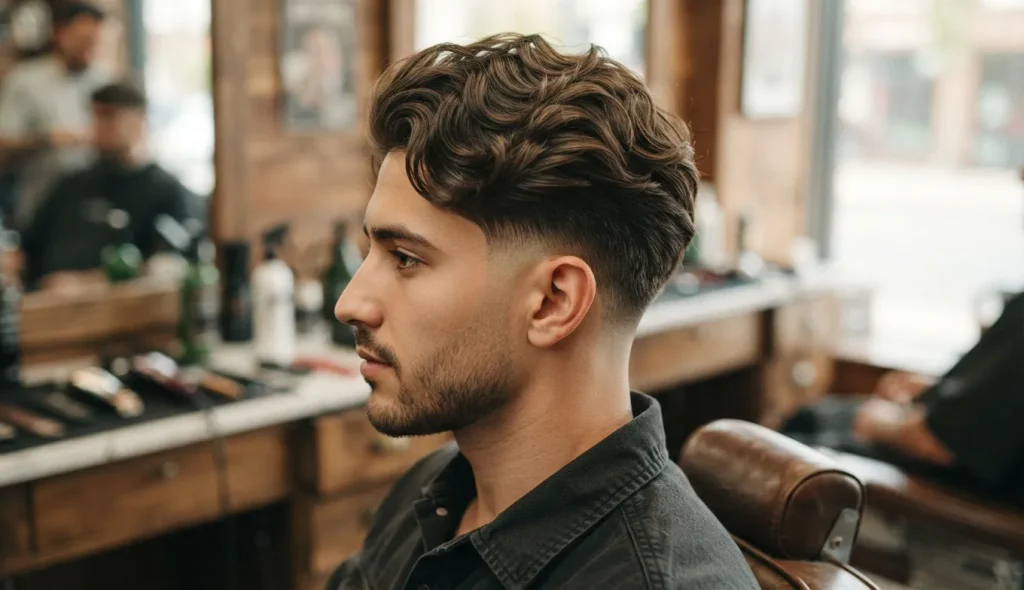
is arguably the easiest texture for this cut. The wave pattern does half the texturing work that point cutting usually handles. A sea salt spray pulls the wave out without weighing it down. Mid to high tapers pair well here, since the fuller top has enough natural texture to balance a sharper side contrast.
Curly hair
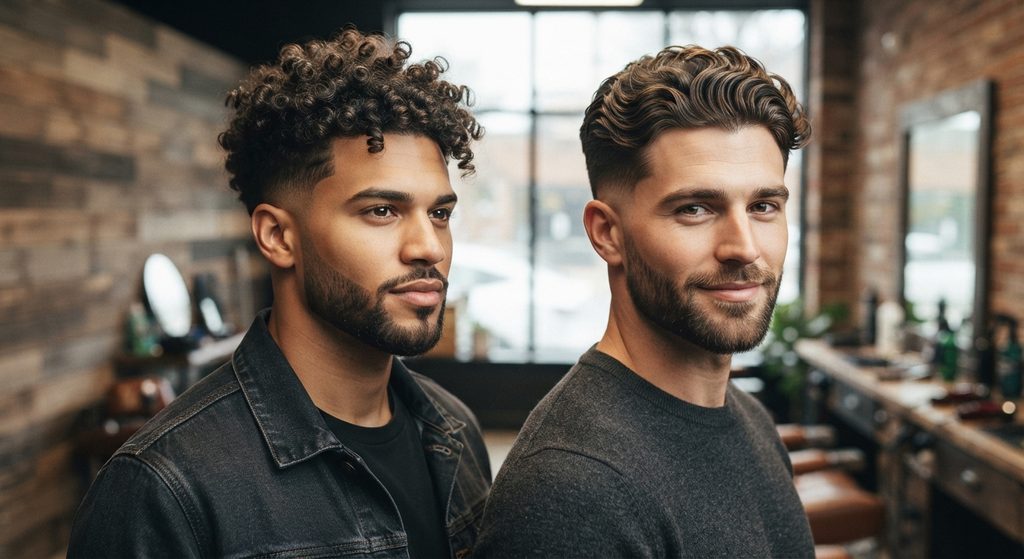
changes the cut’s personality more than any other variable. Curls resist the smooth, lifted shape a blowout is built to create. Barbers who understand curly hair stop fighting the curl pattern instead of forcing it flat. Use curl cream instead of mousse, diffuse instead of blow drying straight, and keep the taper lower so the sides do not compete with an already full top.
READ MORE : Low Taper Haircut for Men: Styles, Guards and Barber Tips 2026
Coily or afro textured hair
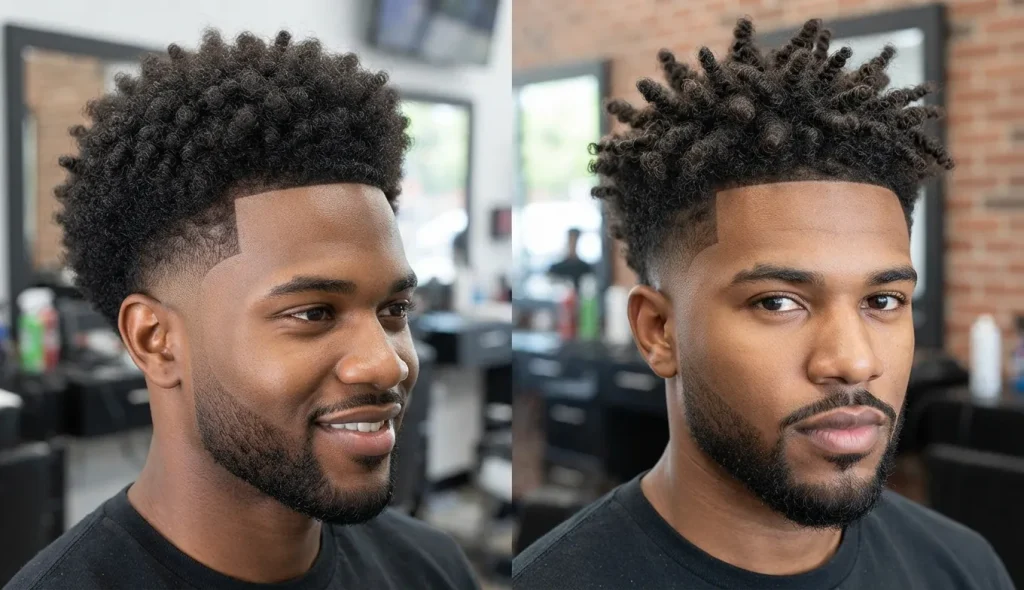
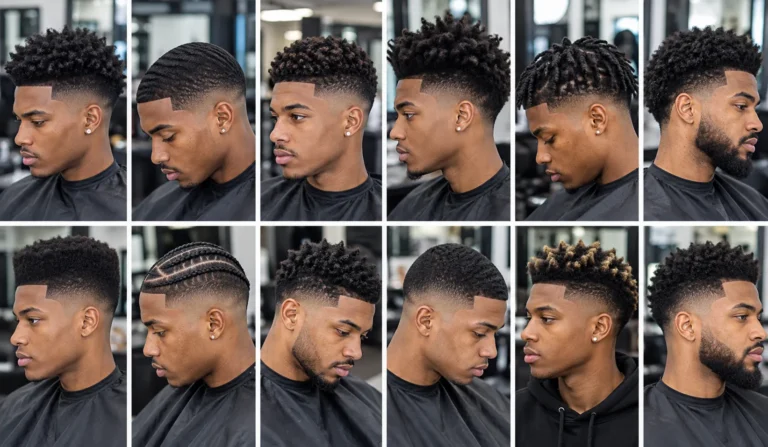
deserves its own mention, since most guides skip it entirely. The taper functions less as a height statement here and more as a frame, a low to mid taper around the perimeter that lets the natural volume and shape of the top do the visual work. A pick or curl sponge does the lifting a round brush would do on straighter textures.
Fine hair
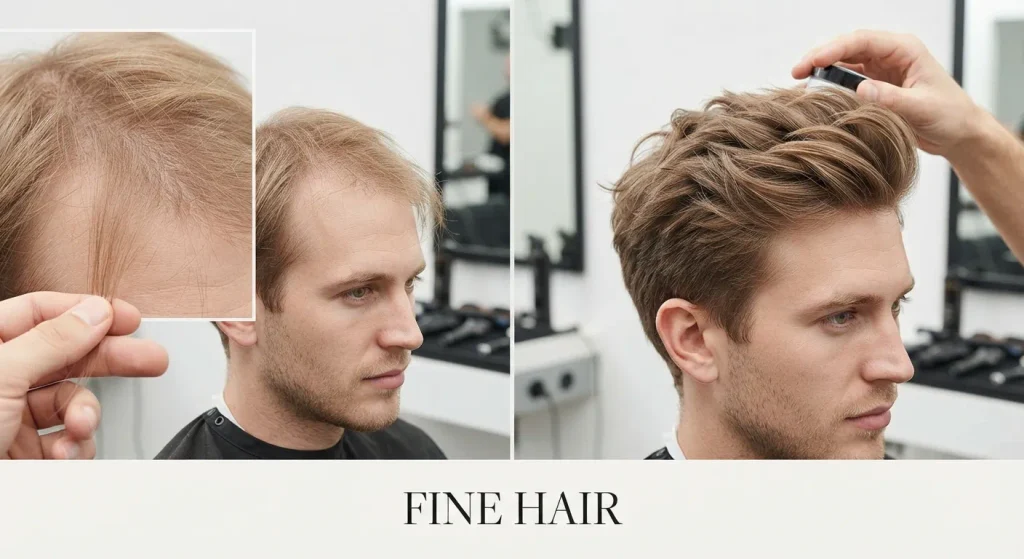
is the texture most likely to disappoint if the barber over thins it. Point cutting removes weight, not density. On already fine hair, aggressive thinning can leave the fringe looking sparse. Keep the fringe slightly longer and lean on root lifting texture powder to compensate.
Thick or coarse hair
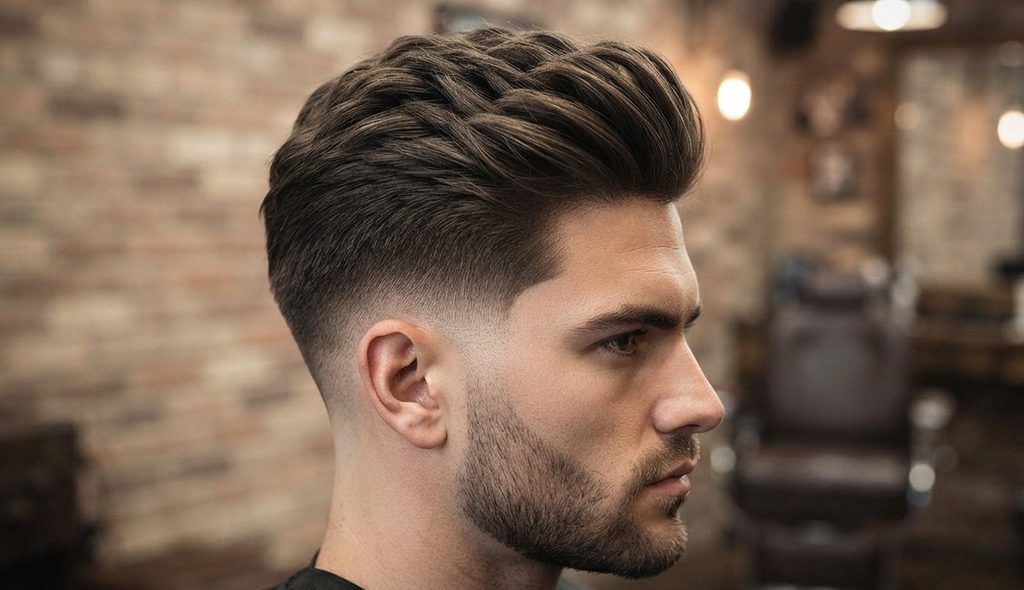
has the opposite problem, too much weight rather than too little. Thinning shears alongside point cutting are a functional necessity here, and not merely a technique worth requesting. Skip it, and a thick fringe reads as a brick no matter how much product goes into it.
Styling It Yourself
Most home styling guides list product names without explaining why order and technique matter more than which brand you buy. Here is the sequence that actually works.
- Dry the hair to damp, not soaking. Fully wet hair takes too long to shape before it starts drying on its own terms.
- Apply a light product, mousse for straight or wavy hair, curl cream for curly hair, at the roots first. Root application gives lift. The ends only need product for definition.
- Use a round brush to physically lift the crown while the dryer runs. The airflow alone does not create volume. The brush tension does.
- Direct the fringe forward or to a side with the brush, not your fingers, until it is mostly dry.
- Finish with a blast of cool air. This locks the hair shaft into the shape it was just held in. Skip it, and the shape relaxes within an hour.
- Work a small amount of matte clay or texture powder through just the ends for separation.
The products that ruin this cut are built for a different silhouette entirely. Heavy pomades and waxes compress hair against the scalp for slicked back styles. Used here, they flatten the exact volume the blowout just created. If a product’s marketing leads with “extreme hold,” it is not for this haircut.
Maintenance: What Actually Determines Your Trim Schedule
The standard advice is every three to five weeks, which is true but incomplete. Three things actually determine where you land in that range.
- Taper height. High tapers show regrowth first, since it happens closest to where the eye lands. Low tapers can stretch toward the five week mark without looking off.
- Fringe length. A longer fringe hides regrowth underneath it. A short fringe has nowhere to hide unevenness.
- Hair growth rate. This genuinely varies person to person, which is why three to five weeks is a range and not an average to aim for.
READ MORE : Textured Fringe Haircut: 11 Styles + What to Tell Your Barber (2026)
Most barbers can clean up just the sides without touching the fringe, which stretches the time between full cuts. If you are intentionally growing the fringe out, say that explicitly and ask for sides only maintenance. Otherwise a barber on autopilot will trim everything evenly, and you will be starting the growth process over.
Common Mistakes That Ruin the Cut
- Skipping trims does not just look messy. It breaks the contrast the whole cut depends on. Once the taper line blurs, there is no visual frame around the fringe.
- Wrong products compress the exact volume the cut is built around. Heavy hold products are mechanically incompatible with a lifted, textured shape.
- Blow drying with no direction leaves you with dry hair, not styled hair. Heat sets whatever shape the hair is in when it dries.
- Vague barber communication produces a different result every visit, because you are outsourcing every decision instead of giving your barber the information to make it consistently.
Blowout Taper Textured Fringe vs. Other Cuts
| Detail | Textured fringe | Blunt fringe | Edgar cut | Curtain fringe |
| Cutting technique | Point cutting | Straight cut | Straight line across | Point cutting, center parted |
| Daily styling | About 10 minutes | Minimal | Precision required daily | Minimal |
| Grows out | Gracefully | Needs frequent trims to stay blunt | Poorly, loses the line fast | Gracefully |
| Best hair type | Straight, wavy | Straight | Straight, thick | Wavy, curly |
| Office read | Clean, modern | Clean, simple | Polarizing, bold | Soft, classic |
This cut sits deliberately in the middle. It takes more effort than a curtain fringe, but far less precision than an Edgar cut, which lives or dies entirely on one perfectly straight line across the forehead. It also pairs well with an undercut on the sides if you want more contrast, or trails naturally into a mullet if you decide to grow the back out.
Is It Office Appropriate?
Yes, for the overwhelming majority of workplaces, and this deserves a specific reason rather than a flat assertion. The taper, versus a fade, avoids the sharp, obviously styled contrast that can read as trend chasing in conservative settings. At the same time, the point cut fringe still signals deliberate effort rather than a default buzzcut. If your workplace leans conservative, keep the taper low and the fringe shorter. The built in flexibility here is what makes it work across settings without needing to become a different haircut.
Frequently Asked Questions
What is a blowout taper textured fringe?
A haircut with tapered sides that never touch skin, paired with a longer fringe on top that is point cut for texture and blown dry forward for lift.
How is it different from a fade with a fringe?
The taper never drops to skin, which makes it lower maintenance and more forgiving as it grows out compared to a faded version of the same fringe.
Does it work with curly hair?
Yes. Use curl cream instead of mousse, diffuse instead of blow drying straight, and lean toward a lower taper so the sides do not compete with the natural volume on top.
How often does it need a trim?
Every three to five weeks, with high tapers on the shorter end of that range and low tapers stretching toward five weeks comfortably.
What is the single most important thing to say to my barber?
Ask for point cutting by name. It is the detail most people forget to mention, and it is the difference between a fringe that moves and one that sits flat.
Is it good for fine hair?
Yes, with adjustments. Keep the fringe slightly longer than you might otherwise, and ask your barber not to over thin it, since fine hair has less density to spare.
Is a blowout taper the same as a quiff?
No. A quiff is swept straight up and back at the front, while a textured fringe falls forward or to one side. You can ask for a quiff shape on the same taper if you prefer more height at the front.
Final Thoughts
Honestly, it makes sense why the blowout taper textured fringe is so popular once you think about it. Not many haircuts work with your face shape, hair type, and daily routine the way this cut does and it still looks like you, no matter who’s got it.
The thing is, what makes a blowout taper textured fringe look intentional instead of like an accident usually has nothing to do with the barber’s skill. It’s what you say before the clippers even start your taper height, how long you want the fringe, and one phrase almost nobody thinks to mention: point cutting.