By M. Haroon | Updated September 2026
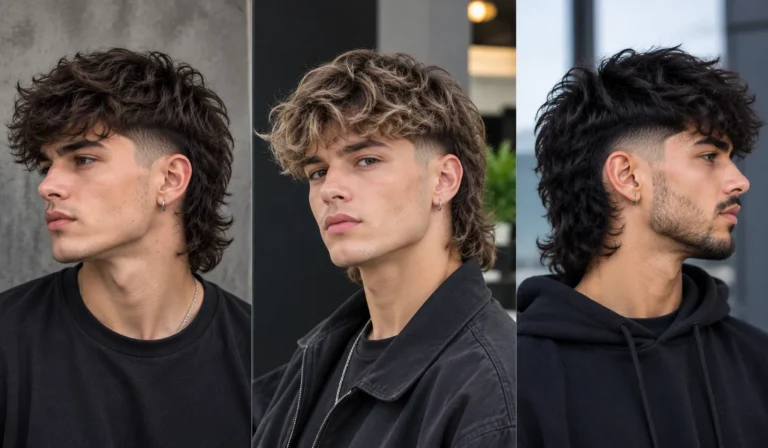
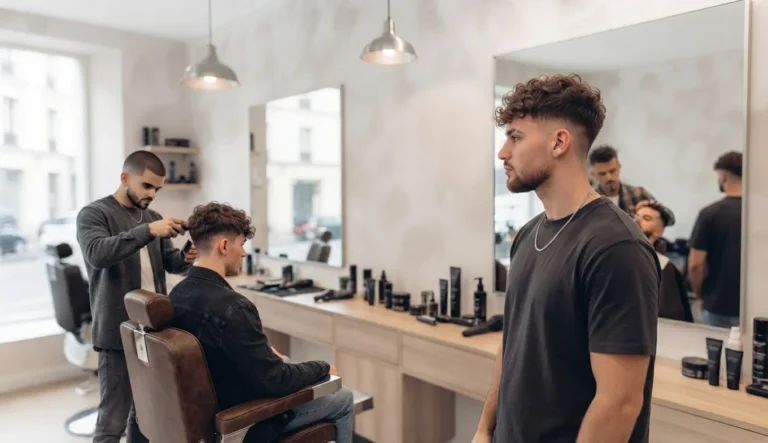
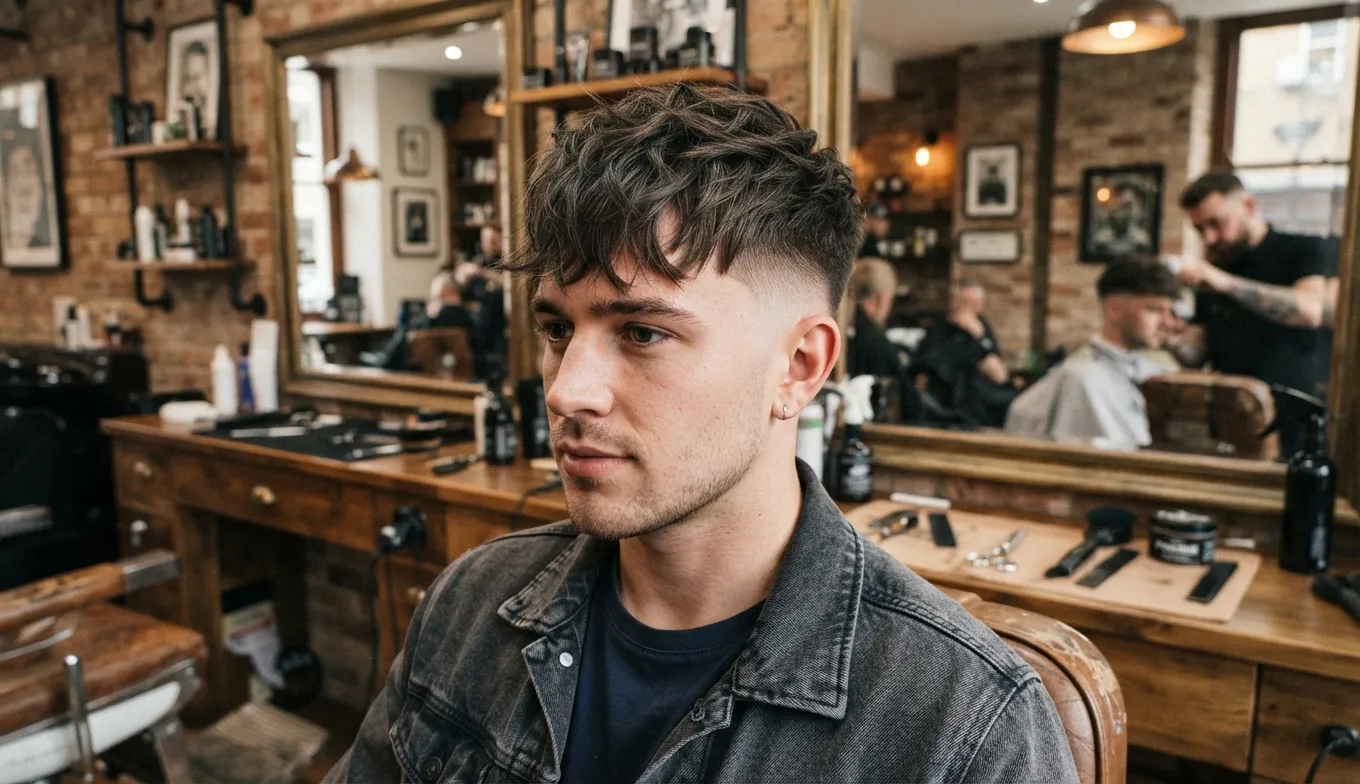
A textured fringe haircut keeps 2 to 4 inches of hair at the front. The barber cuts the ends unevenly, so they fall in loose pieces instead of one flat edge. Barbers pair it with a taper, fade, or scissor cut on the sides. It suits straight, wavy, and loosely curly hair, and it softens a high forehead. Plan a barber visit every 3 to 6 weeks and five minutes of styling. You can get the look in one visit if you name the length and the cutting method. This guide covers eleven versions, a guard chart, and a word for word barber script. You also get fixes for a fringe that goes flat by noon.
Textured Fringe Haircut at a Glance
Here is the whole cut in six lines. Read it before you book.
| Detail | What to expect |
| Front length | 2 to 4 inches, ending between mid forehead and the eyebrow |
| Ends | Cut with scissor tips or a razor so they separate |
| Sides | Taper, fade, undercut, or scissor cut |
| Best hair | Straight, wavy, and loose curls of medium or thick density |
| Rebook | Every 3 to 6 weeks, based on the sides |
| Morning routine | 3 to 5 minutes with clay, paste, or sea salt spray |
What Is a Textured Fringe and How Does It Differ From Lookalikes?

A textured fringe haircut is a cut with 2 to 4 inches of hair left at the front. The barber snips into the ends with scissor tips or a razor, so they separate into pieces. The sides stay short with a taper, fade, or scissor cut. Fringe and bangs mean the same thing. British barbers say fringe. Americans use both words.
The shape traces back to the 1960s mop tops made famous by The Beatles. It came back in the 2020s, and stars such as Timothée Chalamet wear loose, messy versions. Today barbers cut it on short crops and on longer waves.
Several cuts share the silhouette. A Caesar cut is short with a straight, blunt fringe. A French crop keeps a blunt edge too, with a little more length. An Edgar cut is blunter still and boxy across the forehead. A curtain fringe splits in the middle. The broccoli or Alpaca cut is a short, curly version with buzzed sides. A textured crop is the shorter cousin, usually under 2 inches. What sets the textured fringe apart is the broken front edge. If you want that soft edge, say so in the chair.
How Barbers Build a Textured Fringe
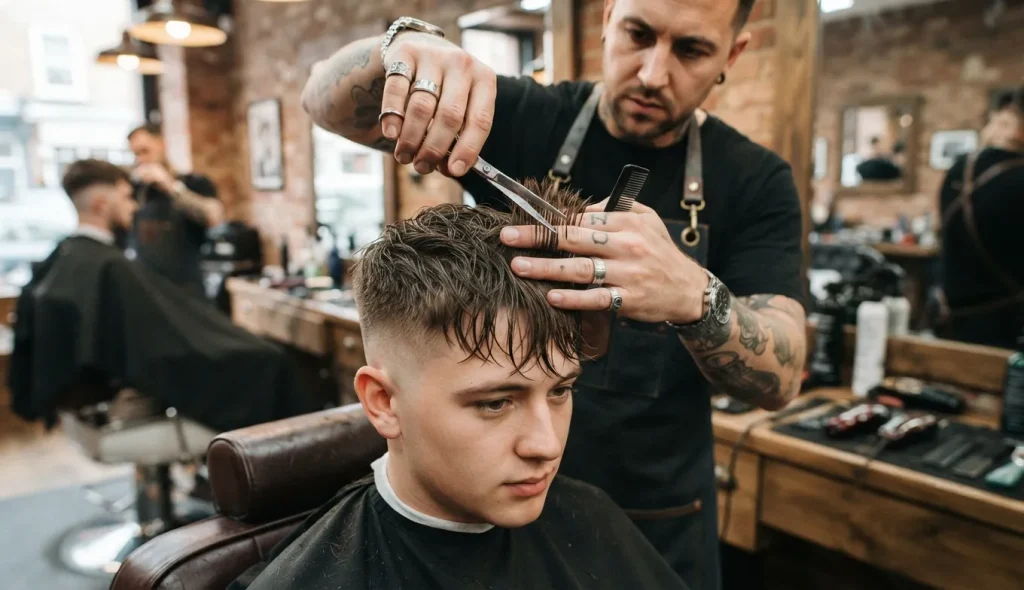
Knowing the order helps you spot a rushed cut. A good barber works like this.
- Check your growth pattern, cowlicks, and hairline while the hair is dry.
- Set the sides with clippers or scissors and blend them toward the top.
- Cut a straight baseline across the front at the length you agreed on.
- Snips into the ends with the scissor tips, holding the blades upright, to break the line.
- Removes bulk from underneath if the hair is thick.
- Dries the hair and checks the front with your head level.
Step 4 is where a fringe becomes a textured fringe. Skip it and you get a blunt crop. Point cutting means snipping into the ends with the scissor tips. Razor cutting shaves them for a lighter finish.
11 Textured Fringe Haircut Versions for Men
Each version changes the sides, the length, or the hair type it suits. Each one ends with a line you can read to your barber.
1. Low Taper With a 3 Inch Fringe
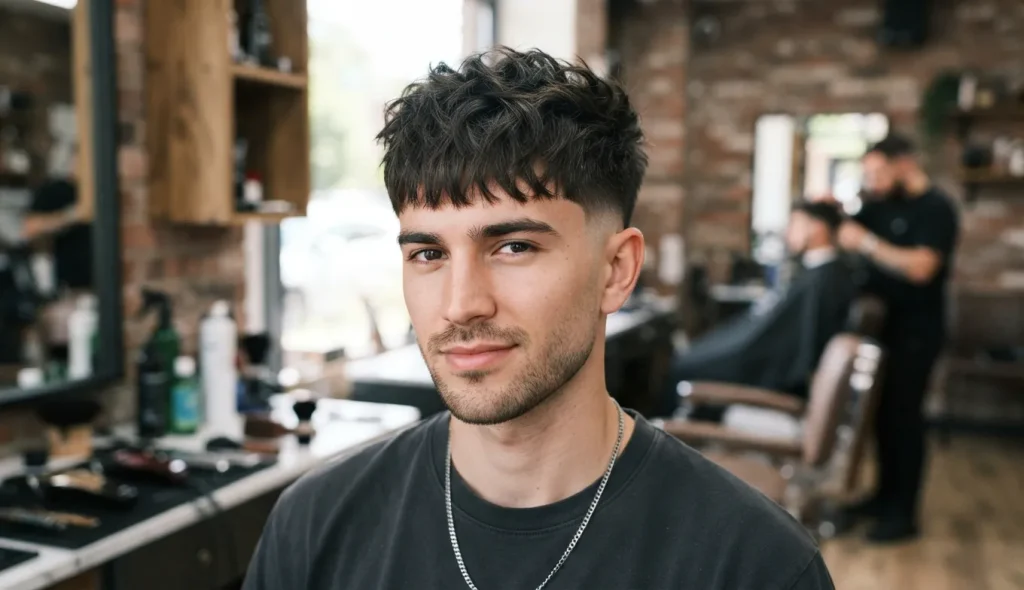
The taper trims the neckline and the edge around the ears, nothing more. The sides keep enough length to look soft as they grow. That makes this the safest choice for an office. Tell your barber: “Taper the neckline and ears only, leave the sides longer, and point cut the front.”
READ MORE : Low Taper Fade Curly Hair: Styles, Tips & Barber Guide 2026
2. Low Fade With Rounded Temples
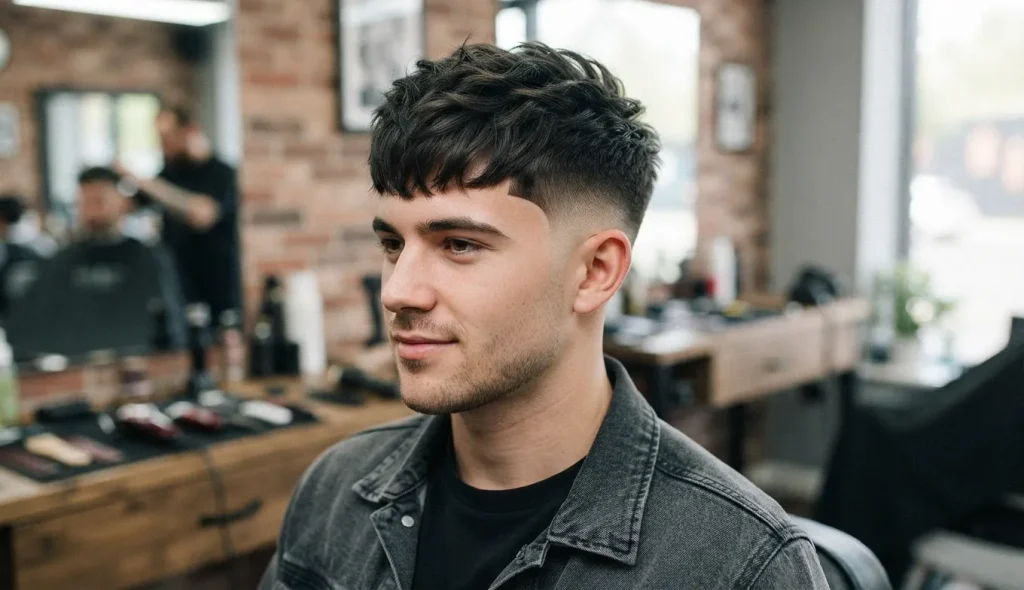
The fade drops to skin just above the ear. You get contrast without a harsh look. Ask for rounded temples, since square corners make the fringe look boxy. Try this: “Low fade above the ear, 3 inches on top, rounded temples.”
3. Skin Fade With a Full Top
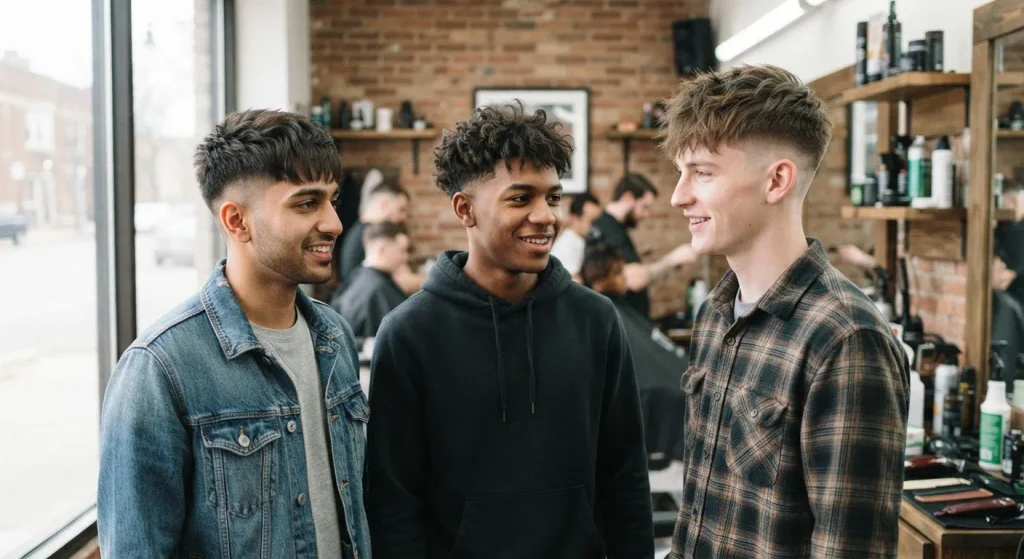
A skin fade starts high and goes to bare skin. It makes the top look thicker. The price is upkeep, because the shape softens within three weeks. Ask for: “Skin fade, keep the top full, point cut the front.”
4. Scissor Cut Sides
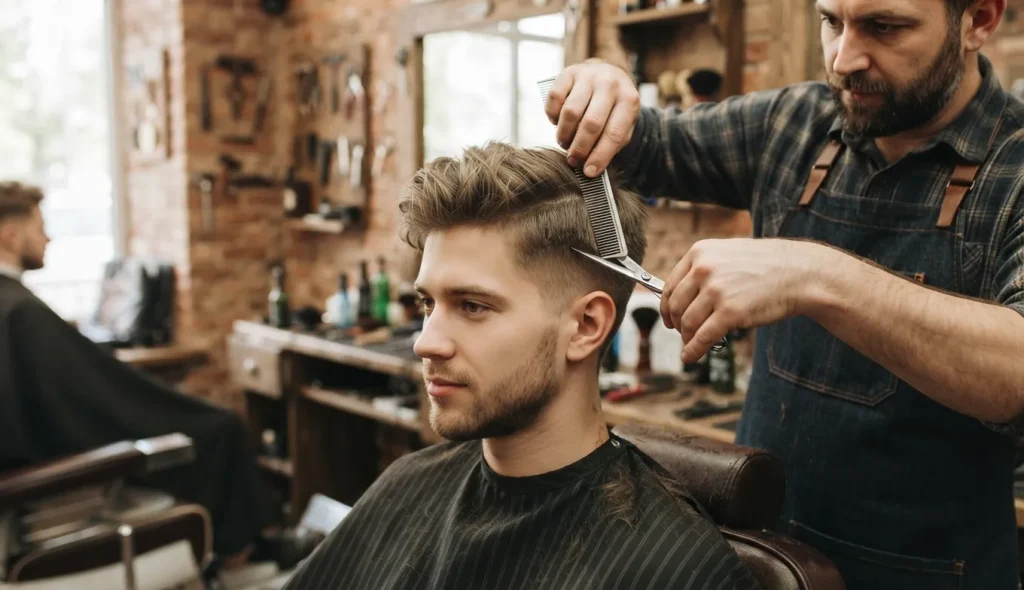
No clippers touch the sides here. The barber cuts them over a comb at about 2 inches and blends them into the fringe. There is no fade line to grow out, so this version lasts longest. The visit runs longer, though. Script: “Scissor cut the sides at about 2 inches and blend into the fringe.”
5. Burst Fade
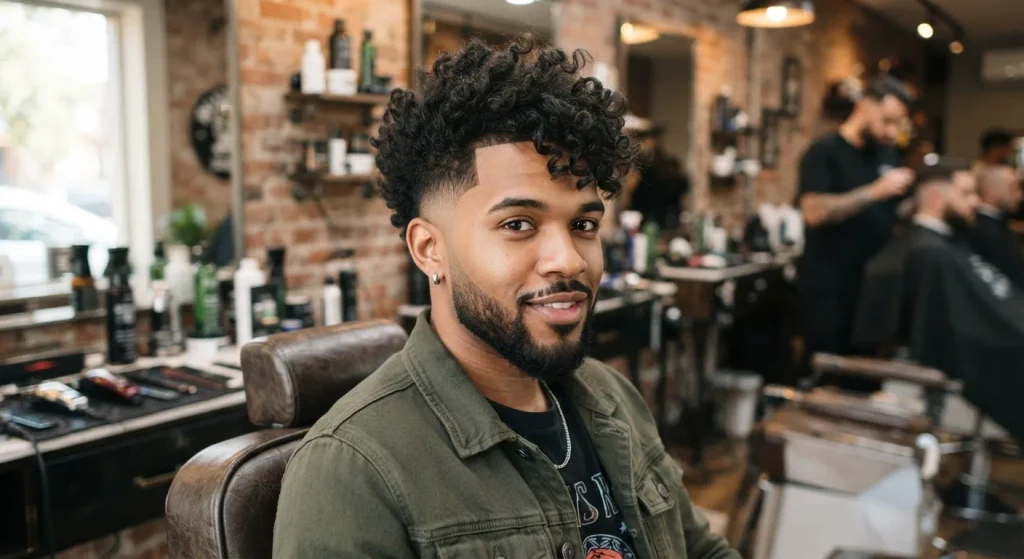
A burst fade curves around the ear and leaves length at the nape. That rounded shape balances a heavy front. Curly and wavy hair fill it best. Some barbers call it a burst taper, so I know both names. Ask for: “Burst fade around the ear, longer at the nape, textured fringe.”
6. Textured Crop for Fine Hair
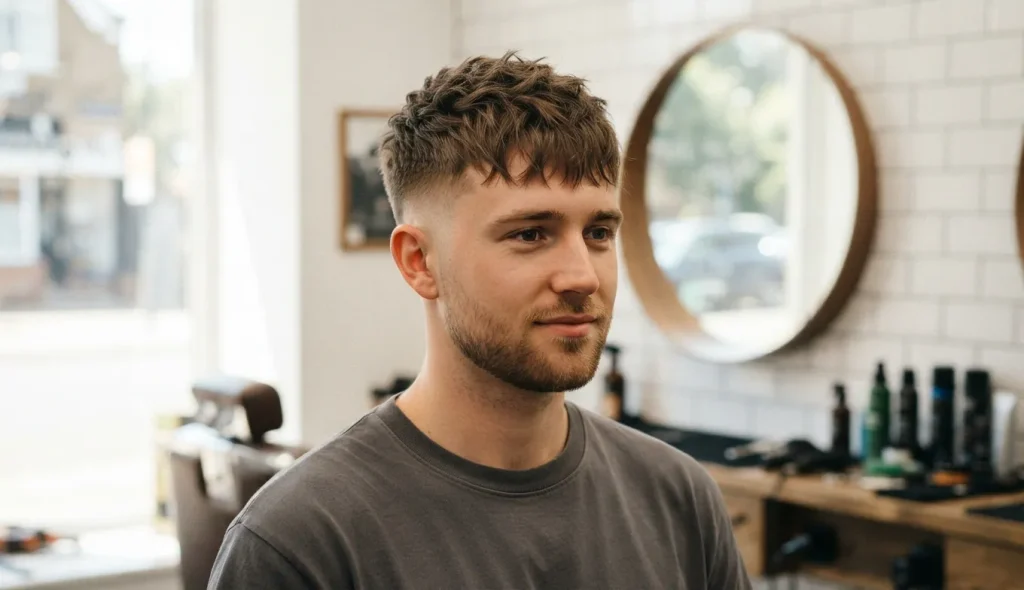
Fine hair holds a shorter front, about 2 inches. Short strands stand up on their own instead of lying flat. Keep the layering light, or the scalp shows. Tell your barber: “Two inches in front, one light layer, tight sides.”
7. Long Fringe With Faded Sides
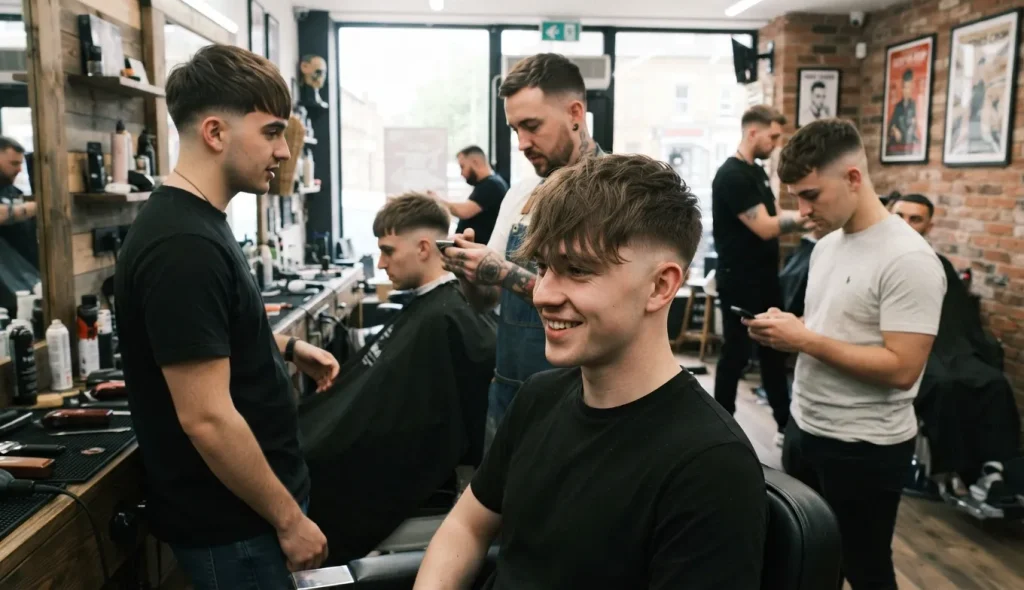
Four inches on top against tight sides is the sharpest contrast in this list. The fade grows into the fringe fast, so plan a visit every three weeks. Can’t commit to that? Choose a taper. Try this: “Four inches in front, faded sides, fringe pushed forward.”
8. Textured Fringe With an Undercut
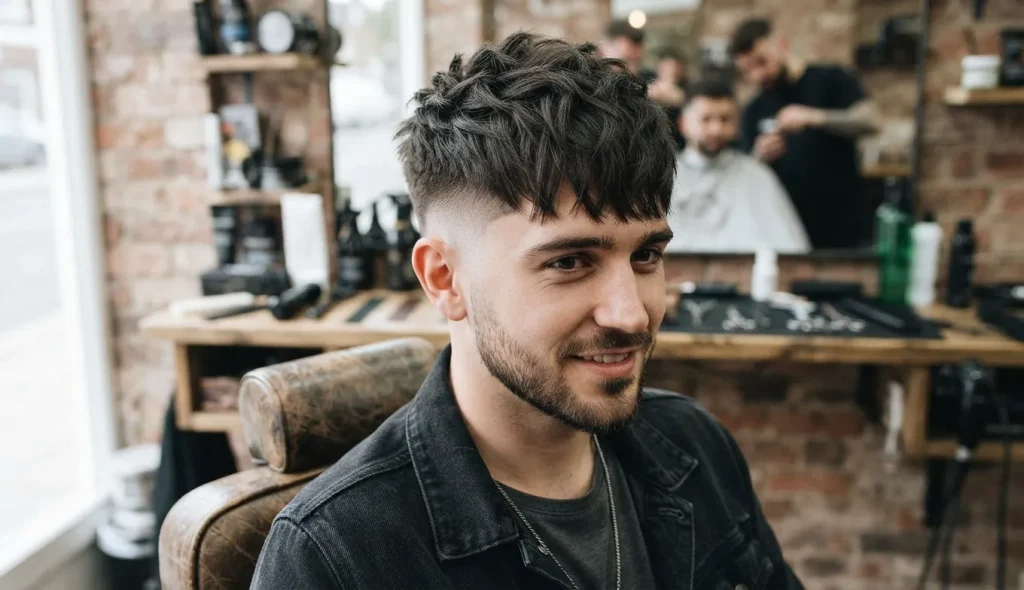
An undercut cuts the sides short and leaves a hard line where the top begins. Nothing blends, unlike a fade. That sharp step shows off a full, choppy top. It suits thick hair and square jaws. Soft, round faces look better with a fade. Ask for: “Undercut sides, 3 inches on top, point cut the front.”
9. Wavy Fringe
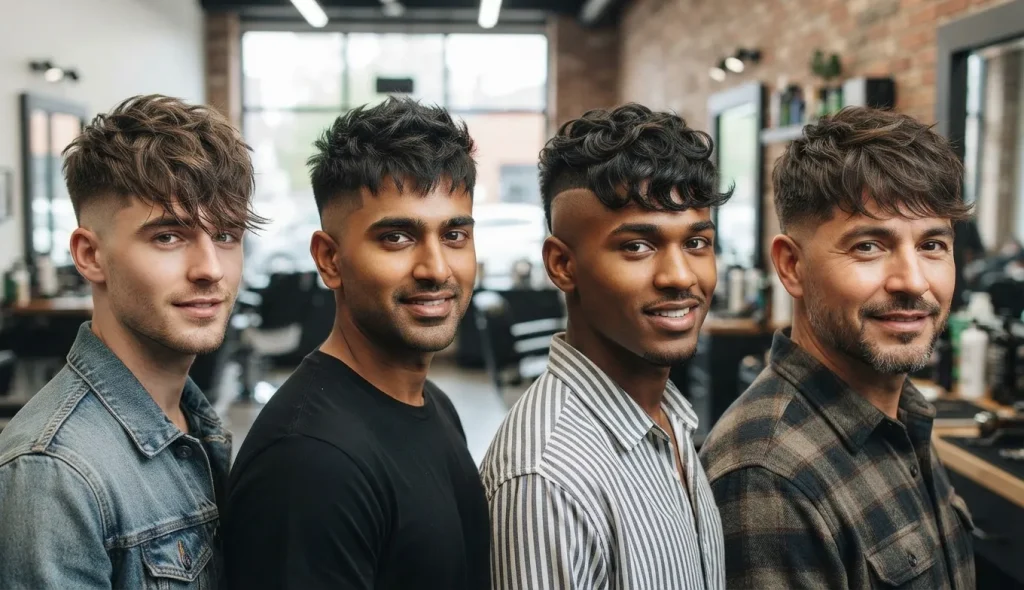
Waves separate on their own once the front passes 3 inches. The barber only needs to remove bulk from underneath. Air dry with sea salt spray. A blow dryer pulls waves straight and fights their pattern. Script: “Three to four inches, light point cutting, keep my wave.”
10. Curly Fringe Cut Dry
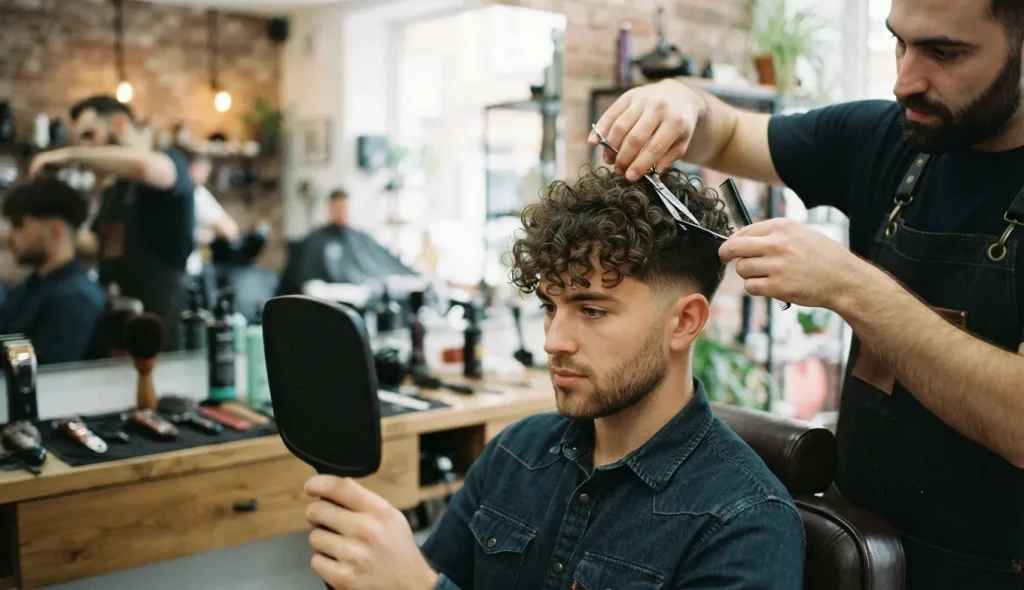
Curls shrink as they dry, so a wet cut can leave the front too short. A dry cut shows the barber the real length. Leave it longer than looks right in the chair. Skip thinning shears, which turn curls into frizz. Tell your barber: “Cut it dry, leave the front long, no thinning shears.”
11. Coily Top With a Shaped Front Edge
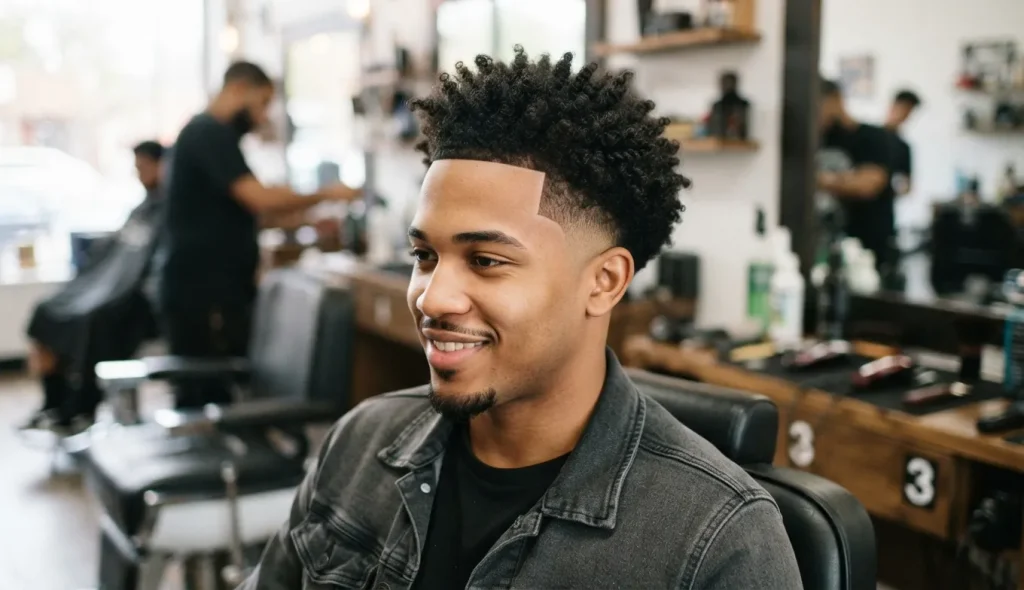
Tight coils don’t fall forward like straight hair. The barber shapes the front edge into a clean, slightly uneven line instead. Density stays intact, and a taper frames the shape. Moisturized Coils define better than dry ones. Try this: “Shape the front edge, keep the density, taper the sides.”
Clipper Guard Chart for the Sides
Guard numbers let you describe the sides in a way every barber understands. On most clippers, including Wahl and Andis, a #1 guard leaves 1/8 inch. A #2 leaves 1/4 inch, a #3 leaves 3/8 inch, and a #4 leaves 1/2 inch.
| Side style | Guard or method | Where it starts | Rebook in |
| Low taper | #2 or #3 at the neck | Ears and neckline | 4 to 6 weeks |
| Low fade | Skin to #1 | Just above the ear | 3 to 4 weeks |
| Mid fade | Skin to #1 | Halfway up the side | 3 to 4 weeks |
| High or skin fade | Bare skin | Near the temple | 2 to 3 weeks |
| Undercut | Short guard, no blend | Hard line at the top | 3 to 4 weeks |
| Scissor cut | Scissors and comb | No fade line | 6 to 8 weeks |
Which Textured Fringe Haircut Suits Your Hair Type and Face Shape?
Hair type changes the cut more than face shape does. The table follows the Andre Walker system, which ranks hair from 1a for straight to 4c for tight coils.
| Hair type | Front length | Ask the barber for | Product |
| Straight, 1a to 1c | 2 to 3 inches | Deep point cutting through the last inch | Matte clay or texture spray |
| Wavy, 2a to 2c | 3 to 4 inches | Light point cutting, bulk removed underneath | Sea salt spray or light cream |
| Curly, 3a to 3c | 3 to 4 inches, cut dry | Shaping only, no thinning | Leave in conditioner, curl cream, diffuser |
| Coily, 4a to 4c | Shaped by outline | Clean front edge, density kept | Water based moisturizer |
| Fine | About 2 inches | One short layer | Texture powder at the roots |
| Thick | 3 to 4 inches | Weight removed underneath | Matte clay or paste |
Fine hair needs less length, and thick hair needs less weight.
The fringe frames the forehead, so its length and angle change how your face reads. Use these matches as a starting point:
- Oval: Most versions work.
- Round: Choose an angled fringe with lift at the roots to break the width.
- Square: Choose softly rounded corners to calm a strong jaw.
- Oblong: Choose a fuller fringe near the brow to shorten the face.
- Heart: Choose a light, piecey front so the forehead looks narrower.
- Diamond: Choose a forward fringe with a little side volume.
Pairing the Cut With a Beard
A fringe and a beard balance each other. Short stubble keeps the focus on the top. A full beard adds weight to the jaw, so keep the fringe a little longer to match. Ask the barber to fade the sides into the beard line so no gap shows at the ear. A very short fringe above a long beard can look unbalanced.
When Another Cut Fits Better
This cut has limits. These cases call for a different plan.
- Very fine, sparse hair at the front. The scalp shows through. A short crop looks fuller.
- A hairline past the mid scalp. The fringe has nothing to sit on. A shorter cut looks planned.
- A dislike of hair on your forehead. If you push it back all day, the fringe will annoy you.
- A cowlick at the front hairline. It pushes the fringe sideways. Ask the barber to read the growth first.
- A skin fade and a busy calendar. That pairing turns shapeless fast. Choose a taper.
- Fast or patchy hair loss. See a board certified dermatologist first. The American Academy of Dermatology lists them.
How to Ask for a Textured Fringe Haircut
The name alone leaves too much open. Give the barber numbers and verbs.
READ MORE : Mid Taper Fade Fringe: The Complete Guide 2026
Try this script: “Leave three inches in the front. Snip into the ends with the scissor tips so they separate. Taper the sides and keep the temples rounded. I style it with matte clay for about five minutes.”
Learn five terms so you can follow the talk:
- Point cutting: snipping into the ends with the scissor tips.
- Razor cutting: shaving the ends for a lighter finish.
- Weight removal: taking bulk out from underneath the top.
- Baseline: the first straight line the barber cuts across the front.
- Guard number: the clipper attachment that sets the side length.
Bring one photo from the front and one from the side. Ask the barber to check the length once the hair is dry, since wet hair sits lower and hides the true length. Ask the barber to avoid thinning shears on the front. They leave hairs at mixed lengths, and the short ones stick up as they grow.
Can You Trim a Textured Fringe at Home?
You can tidy the front tips. Hold the scissors upright and snip a few millimeters into the longest pieces. Leave the sides to a barber. A crooked fade line takes weeks to hide.
How to Style a Textured Fringe in 5 Minutes
Styling adds grip and separation. Too much product makes the fringe look greasy.
- Start with damp hair, not wet. Towel dry until it stops dripping.
- Blow dry the roots with your fingers, pushing the front up and back for lift.
- Let the front fall forward and set it with a blast of cool air.
- Warm a pea sized dab of product in your palms until it disappears.
- Rake it through from root to tip, then pinch the ends into pieces.
Curly hair skips the brush. Use a diffuser on low heat or air dry. Pick your product from the hair type table above, and start with less than you think you need.
Textured Fringe Haircut Maintenance and Grow Out
The American Academy of Dermatology notes that scalp hair grows about half an inch a month. A fringe at the eyebrow reaches your eyes in roughly two months. Trim the front every 3 to 4 weeks, even when the sides last longer.
| Side style | Full visit | What you notice first |
| Skin fade | 2 to 3 weeks | The contrast softens |
| Low fade | 3 to 4 weeks | The fade line blurs at the ear |
| Taper | 4 to 6 weeks | The neckline fills in with no hard line |
| Scissor cut sides | 6 to 8 weeks | It reads as longer hair |
| Curly fringe | 6 to 8 weeks | Width builds and weight needs removing |
Fix Common Fringe Problems
- It falls flat by noon. Use less product and rough dry the roots. Add texture powder at the roots.
- The roots look greasy. Start with clean hair and switch to a lighter clay.
- A cowlick pushes it the wrong way. Tell your barber. A slightly longer crown lets the growth help.
- It pokes into your eyes. Trim the tips or dry the roots upward for lift.
- The growth looks messy. Ask for a taper. It keeps a clean shape while the length builds.
Textured Fringe Haircut FAQs
What is a textured fringe haircut?
It is a longer front section cut with broken, uneven ends. Barbers use point cutting or a razor, so the hair moves in pieces. The sides stay short. The result looks casual, and it doesn’t have the solid edge of a blunt fringe.
How long must my hair be?
You need at least 2 inches at the front. Three to four inches gives you more options. Growing from a buzz cut takes about 3 to 4 months for 2 inches and 5 to 6 months for 3 inches. You can shape the sides while you wait.
How is it different from a French crop?
A French crop has a blunt front edge and stays shorter. A textured fringe has broken ends and more length. From a distance they look alike. Ask for point cutting if you want the softer edge.
Does it work on straight hair?
Yes, but the barber must build the movement. Straight hair has no bend to separate on its own. Ask for deep point cutting and a front near 2 to 3 inches. Rough dry the roots, then use clay or powder for grip.
Can curly hair carry a textured fringe?
Yes. Curls separate on their own, so the barber should shape, not thin. Ask for a dry cut, because wet curls stretch and sit shorter once dry.
Will it hide a receding hairline?
A short fringe pushed forward covers receding corners when the loss stays near the temples. Keep it near 2 to 3 inches. Longer hair splits and shows scalp. See a dermatologist if the loss is fast.
Is it office friendly?
Yes. Keep the front at or above the eyebrow, choose a taper, and use a matte product. That mix reads neat in most workplaces.
Conclusion
A textured fringe haircut keeps 2 to 4 inches of hair at the front, cut with point-cutting or a razor so the ends separate into loose pieces instead of a straight, blunt edge. It works with any side style, taper, fade, undercut, or scissor cut, and suits straight, wavy, curly, and coily hair. Most people rebook every 3 to 6 weeks and spend just a few minutes styling it each morning with clay, paste, or sea salt spray.
The guide breaks the cut into 11 versions (low taper, skin fade, burst fade, undercut, curly, coily, and more), along with a clipper guard chart, hair-type and face-shape matches, exact barber scripts for each look, a styling routine, maintenance timelines, and fixes for common problems like a fringe that falls flat or turns greasy.